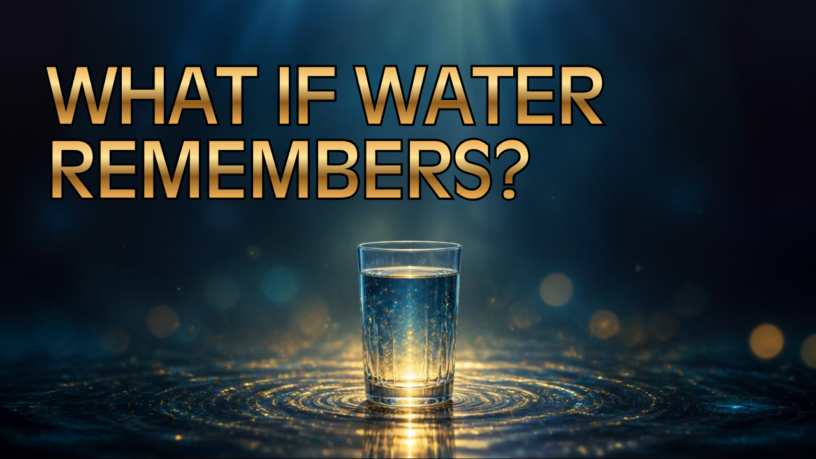


Memory, Vibration, and the Power of Intention
What If the Most Common Substance on Earth Is Also the Most Sensitive?
An Element That Listens
Water covers more than seventy percent of this planet. It makes up the majority of our bodies, flows through every living system we know of, and has been present on Earth for billions of years. We drink it, bathe in it, are born in it. It is so familiar that we rarely pause to consider what it might actually be.
But what if water is not simply a passive substance? What if it receives, responds, and remembers?
This question sits at the intersection of science, spirituality, and something older than both — an intuition, carried across cultures and centuries, that water is alive in ways we do not yet fully understand. It may not fit neatly into a laboratory. But it fits, with remarkable precision, into the lived experience of those who have paid close attention to it.
The Memory of Water
The idea that water can retain information — that it carries something like a memory of what it has encountered — has been both fascinating and controversial for decades.
The researcher most associated with this concept is Dr. Masaru Emoto, a Japanese scientist and author who spent years photographing water crystals under different conditions. His central claim was striking: water exposed to positive words, music, and intentions formed beautiful, symmetrical crystals when frozen. Water exposed to negative words, aggression, or disharmonious sound formed distorted, irregular structures.
The scientific community has largely criticized Emoto’s methodology — questioning the controls, the reproducibility, and the interpretation of results. These criticisms are legitimate and worth acknowledging. Rigorous science has not confirmed water memory as a measurable, consistent phenomenon.
And yet.
The question his work opened is not so easily closed. Because what Emoto was pointing toward — the idea that energy, intention, and vibration influence matter — is not foreign to physics. It is, in fact, one of the directions quantum research continues to explore. Water’s molecular structure, held together by hydrogen bonds of unusual flexibility and responsiveness, makes it arguably the most receptive substance in nature. Whether or not it “remembers” in a way that science can currently measure, the conversation it started remains alive and worth having.
Water and the Language of Vibration
Sound is not abstract. It is physical — a wave of pressure moving through matter, reorganizing what it passes through.
Water responds to sound in ways that are visible even to the naked eye. Low frequencies cause it to ripple. Certain tones create geometric patterns on its surface — structures of surprising mathematical elegance, documented in the field of cymatics. The right frequency can cause water to dance; the wrong one can cause it to churn.
This is not metaphysics. This is physics.
What becomes more philosophically interesting is the extension of this principle: if structured sound — music, frequency, vibration — visibly affects water’s behavior, what might less structured but equally real energies do? What about the energy of words spoken over it? Of emotions felt near it? Of intentions directed toward it?
These questions cannot yet be answered with certainty. But they cannot be dismissed without intellectual honesty either. And for those who approach water as a living element rather than an inert liquid, the answers have already begun to arrive — through experience, through practice, through a growing attentiveness to what water seems to reflect back.
Words Have Weight
Among the most quietly radical implications of Emoto’s work is this: the words we speak may not simply disappear into the air.
If water responds to language — to the frequency carried within sound, to the intention embedded in words — then every conversation, every internal monologue, every prayer or curse spoken near water leaves a trace. And given that our bodies are composed of more than sixty percent water — our muscles seventy-six percent, our blood eighty-three percent, our lungs ninety percent, and our brains a remarkable ninety-five percent — the implications become deeply personal.
We are, in the most literal sense, mostly water.
Which means that what we say to ourselves — the quality of our inner dialogue, the emotional charge we carry, the stories we repeat — may be shaping the very substance of which we are made. The harshness we direct inward does not simply affect our mood. It moves through a body that is almost entirely receptive, responsive, and — if water’s properties are even partially what researchers like Emoto suggested — listening.
This is not an invitation to magical thinking. It is an invitation to take our inner world seriously as a physical reality.
Music as Medicine for Water — and for Us
Music has always been understood, across cultures, as something more than entertainment. It is healing technology. It is prayer made audible. It is the organization of vibration into something the human body recognizes as meaningful.
The relationship between music and water adds a layer to this understanding. Harmonious, coherent music — whether classical compositions, sacred chants, or natural soundscapes — appears to support more organized, coherent structures in water. Dissonant, chaotic sound appears to do the opposite.
If this is true of water in a glass, it is worth sitting with what it might mean for the water inside us. The music we surround ourselves with, the sounds we habitually expose ourselves to, the tonal quality of the voices and environments in our daily lives — all of this is, in a sense, speaking directly to our inner ocean.
Choosing music consciously, then, is not simply an aesthetic preference. It may be one of the simplest and most underestimated acts of self-care available to us.
Practical Ways to Work With Water’s Intelligence
Whether approached as spiritual practice, psychological ritual, or simply a more conscious relationship with a substance central to life, there are many ways to engage with water’s potential responsiveness. None of these require belief as a prerequisite — only openness, intention, and a willingness to pay attention.
Blessing your water. Before drinking, pause. Hold the glass in both hands and direct a clear, positive intention toward it — silently or aloud. May this water nourish and restore me. This takes ten seconds and costs nothing. What it cultivates, over time, is a habit of presence and gratitude around something we otherwise consume unconsciously.
Mindful hydration. As you drink, be there for it. Feel the water moving through you. Visualize it reaching your cells, your tissues, your bloodstream. This is not fantasy — it is a form of somatic awareness that deepens the body-mind connection with every glass.
Exposure to harmonious sound. Place water near music, singing bowls, or natural sounds before using it. Whether or not this changes the water’s molecular structure, it changes the quality of your attention — and that, in itself, has value.
Ritual baths with intention. Water has been used for purification and renewal across virtually every spiritual tradition on Earth. A bath taken with clear intention — with specific herbs, salts, or oils chosen consciously — becomes something more than hygiene. It becomes a ceremony of reset, of release, of renewal.
Structured water. Some practitioners expose water to sunlight, moonlight, or the presence of healing crystals, believing these influences support a more coherent molecular arrangement. Whether viewed scientifically or symbolically, the practice of treating water as something worth caring for shifts our relationship to it in ways that ripple outward.
Dowsing and the Programming of Water
For those who work within the practice of dowsing and radiesthesia, water holds an additional dimension of possibility.
In dowsing practice, it is possible to create a specific energetic algorithm — a carefully formulated intention, checked for alignment with the highest good — and to consciously infuse it into water. The process is precise and meditative:
You begin by crafting your intention with clarity and care. Then, in a quiet space, you place clean water before you and settle into stillness. With eyes closed and breath deepened, you bring the intention fully into your awareness — not as a wish, but as an already-present reality. As the intention crystallizes in your mind, you gently rotate your hands above the water’s surface in a counterclockwise direction, facilitating the transfer of that intention into the water’s field.
What results is water that has been consciously charged — not by magic, but by the focused convergence of human intention and water’s inherent receptivity. Drinking it becomes an act of integration: you are not simply hydrating. You are receiving back, through the medium of water, the intention you placed into it.
This practice is not for everyone, and it requires a foundation of energetic literacy to do well. But for those already working within these frameworks, it represents one of the most elegant applications of water’s responsiveness available.
The Mirror We Carry Inside Us
Here is perhaps the most important thing to carry away from all of this.
You are not observing water from the outside. You are water — in the most literal, biological sense. Your muscles, your blood, your brain, your heart: all of it is primarily water. All of it is, according to everything we’ve explored here, responsive to vibration, to sound, to words, to intention.
This means that every harsh word you speak to yourself moves through a body that is listening. Every moment of gratitude, of joy, of genuine loving-kindness directed inward — that moves through it too.
The ripple effect is not a metaphor. It is a physiological reality.
When we choose to speak kindly — to ourselves and to others — we are not simply being polite. We are choosing the quality of the internal environment in which every cell of our body lives. When we surround ourselves with harmonious sound, with beauty, with intention — we are tending to an inner ocean that is always, quietly, taking its shape from what we pour into it.
Water has been teaching this for as long as it has existed.
Perhaps we are only now becoming ready to hear it.
If this resonated with you, there is more to explore.
Subscribe to Alma Noble and receive the Mindful Soul Starter Kit as a welcome gift for your journey.
Claim Your FREE Soul Starter Kit
















Leave a Reply