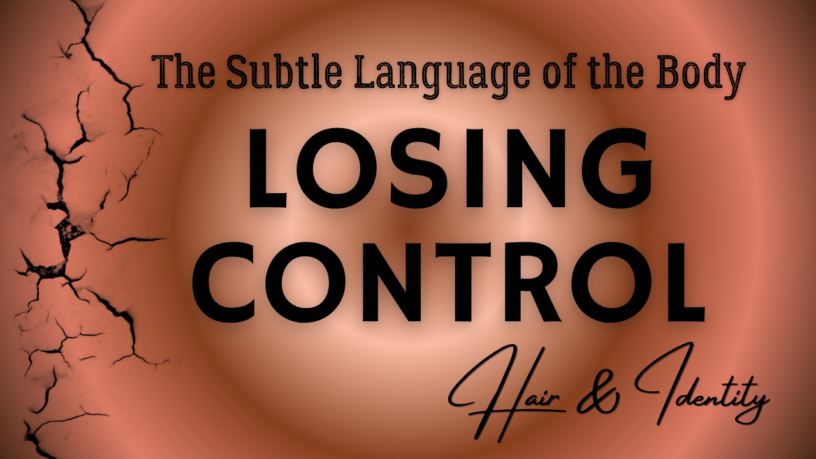



The Body Keeps the Score — and few things carry the record more faithfully, or more silently, than the strands we grow, lose, inherit, and sometimes choose to leave behind.
There is a moment, recognizable to almost anyone who has experienced significant hair loss, that has nothing to do with vanity.
It is the moment you look at the drain, or the pillow, or the brush — and you understand that something is leaving. Not just hair. Something harder to name. A version of yourself, perhaps. A sense of the body as something reliable, something yours. A story you had been telling about who you are and how you appear in the world.
Hair is never just hair. It never has been.
What Hair Actually Does
Biologically, each strand grows from a follicle — a living structure embedded in the scalp, fed by blood vessels, governed by hormones, influenced by the nervous system, and sensitive to everything happening in the body’s interior landscape.
Hair is not inert. It is not decorative in the way a piece of jewelry is decorative. It is a living extension of the body’s systems — a kind of external expression of what is happening internally, much like the rings of a tree carry the record of every drought, every flood, every season of abundance and scarcity.
And then there is something that most people never learn, though it is simply biology: a strand of hair is an archive.
When forensic scientists or toxicologists want to understand what has been moving through a person’s body — which substances, which hormones, which traces of stress or illness or exposure — they turn to hair. A single strand, analyzed segment by segment, can reconstruct a timeline. What was ingested, when. What the body was producing under pressure, and for how long. Hair does not forget. It encodes, in its very structure, the chemistry of the life being lived inside the person who grew it.
This is not metaphor. This is what hair does, quietly, while we go about our days.
The Symbolic Layer: What Hair Has Always Meant
Long before forensic science discovered that hair holds a chemical record, human civilizations understood — intuitively, through observation, through spiritual practice — that hair was something more than filament.
In many ancient traditions, hair was considered a direct extension of a person’s vital energy, their life force, their connection to something beyond the purely physical. Among certain Indigenous peoples of the Americas, hair was understood to be a sensory organ — a kind of antenna, an extension of the nervous system that could perceive what the ordinary senses could not. Cutting it, in some traditions, was done only in mourning — because to cut the hair was to sever a connection, to mark an ending, to signal to the world and to the self that something fundamental had changed.
In ancient Egypt, Mesopotamia, and across much of the ancient world, the length and styling of hair was a marker of social and spiritual standing. Not everyone was permitted to wear their hair in every way. Certain styles, certain lengths, certain treatments were reserved — for priests, for warriors, for royalty — because hair was understood to carry something. Authority. Power. Access to realms of perception and influence not available to everyone.
The Sikh tradition maintains, to this day, that hair — kesh — is sacred. It is kept uncut as a symbol of acceptance of what has been given, of living in harmony with one’s nature rather than imposing the ego’s preferences upon it. The hair, in this view, is not incidental. It is part of the spiritual instrument that is the body.
In the Western esoteric tradition, it has long been held that hair acts as a kind of conduit — that the energy of a person moves through it, that it extends the body’s field into the world. This is why, in fairy tales and folklore across Europe and beyond, a strand of hair is often the ingredient required for the most powerful workings — love, binding, transformation. You needed the actual person, encoded in their hair, to do something real.
Whether one holds these views literally or poetically, they point to something that modern science is only beginning to confirm: that hair is not passive. It participates in the body’s larger systems in ways we are still mapping.
When Things Start to Break
Hair loss is one of the body’s most eloquent and least understood signals.
The pathways are physiological, and they are real. Cortisol — the primary stress hormone — disrupts the hair growth cycle by pushing follicles prematurely into the resting phase. The result, known as telogen effluvium, is a diffuse shedding that typically begins two to three months after a significant stressor. This delay means that by the time the hair falls, the crisis that triggered it may feel distant — which makes it easy to miss the connection entirely.
Thyroid imbalances, autoimmune responses, severe nutritional depletion, hormonal shifts — all of these disrupt the follicle’s environment and manifest, eventually, on the surface. The hair becomes the visible record of what the internal environment has been enduring.
But beyond the physiology, there is a pattern that practitioners of body-oriented medicine, somatic psychotherapy, and traditional Chinese medicine have observed and documented in different ways: hair loss often accompanies a period in which a person’s sense of personal power, control, or identity has been significantly destabilized.
In traditional Chinese medicine, hair is governed by the liver and the kidneys — two organs associated, in this system, with the management of stress and the storage of vital essence. The liver governs the smooth flow of qi, the body’s functional energy. When that flow is obstructed — by prolonged frustration, suppressed anger, chronic anxiety, or the particular kind of internal tension that comes from living in a situation one cannot control — the nourishment to the hair follicles is disrupted. When the kidney essence is depleted — by fear, by prolonged insecurity, by the exhaustion of having held too much for too long — the hair, as an expression of that essence, begins to reflect the depletion.
This framework does not assign blame. It offers a map.
What Was Inherited: When the Loss Begins Before You Do
There is a particular and often unacknowledged experience — the experience of those who are born into, or grow up with, a body that does not produce what the world has decided is normal.
For some women, hair loss or significant thinning is not the result of a crisis or a treatment. It is simply what was passed down. A mother who wore a wig. A grandmother who covered her head. A lineage in which the women moved through the world carrying a private difference — often invisible to others, always present to themselves.
This is a different kind of loss. Or perhaps more accurately — it is a loss that was never preceded by having. It is the inheritance of an absence.
What does it mean to spend a lifetime in a body that does not match the image the world holds for people who look like you? What does it mean to cover, to conceal, to adapt — not because something happened, but because this is simply what you were given?
In somatic and systemic approaches to wellbeing, inherited conditions carry not only their biological dimension but also their relational and ancestral one. When something passes through generations — a physical characteristic, a tendency, a vulnerability — it often carries with it the emotional context in which it lived in the people who came before. The grandmother who was ashamed. The mother who learned to be silent about it. The daughter who inherits both the condition and the silence.
Becoming conscious of this inheritance — not to blame the ancestors, but to understand what was passed down and what can, perhaps, be put down — is its own form of healing. The physical reality may not change. But the relationship to it can.
The Gender Dimension: Two Very Different Relationships to the Same Loss
Hair loss does not mean the same thing in a man’s body as it does in a woman’s. Not physiologically, not culturally, and not emotionally.
For women, hair is entangled — in ways that are both cultural and deeply personal — with femininity, with desirability, with the visible expression of identity and vitality. When a woman loses her hair, she often loses something that the world has long told her is central to her womanhood. The shame that can accompany this is disproportionate to the biological reality — but it is real, and it deserves to be named rather than minimized.
Women who lose hair to illness — and particularly to chemotherapy — navigate a particularly layered experience. The hair loss is not only a side effect. It is a public declaration of the private battle. It makes invisible suffering visible. It removes the option of passing, of appearing fine, of maintaining the boundary between the sick self and the self that moves through the world. For some women, this exposure is experienced as a kind of violation. For others, over time, it becomes something else — a strange clarity, a permission to stop performing wellness, an encounter with a self that exists beneath the presentation.
The hair that returns after treatment — and it does, for many — is rarely exactly what was there before. Different texture. Sometimes different color. As though the body, having been through fire, grows something new from what survived.
For men, the relationship is different in texture but no less complex. Male pattern baldness is so normalized — so thoroughly woven into the cultural narrative of aging masculinity — that its emotional weight is often dismissed or mocked rather than acknowledged. And yet research consistently shows that men who experience early or significant hair loss report meaningful impacts on self-esteem, particularly in their twenties and thirties, when the gap between the self they imagined and the self they see in the mirror can feel most acute.
There is an important distinction, however — one that the cultural conversation rarely makes clearly enough: there is a profound difference between losing hair and choosing to remove it.
The man who shaves his head in response to thinning is not the same as the man who shaves his head as an act of aesthetic preference or deliberate self-definition. One is a response to loss; the other is a reclamation of agency. One happens to you; the other you do to yourself — and that distinction, at the level of the nervous system and the psyche, is not trivial.
And then there are men who simply prefer it — who feel more themselves without hair, more direct, more present, unburdened by a feature they never identified with strongly. For these men, the shaved head is not about loss at all. It is a form of clarity.
What is worth noticing, in all cases, is the emotional quality of the relationship to the hair or its absence. Is there peace there? Grief that has been worked through? Or is there something still raw, still avoided, still carried in the body as tension or shame?
The Pattern Nobody Talks About
When hair loss is sudden and significant — beyond what aging or genetics would explain — it rarely arrives alone.
It tends to arrive in the company of a period in which the person has felt profoundly out of control. Not just stressed — genuinely unable to direct the course of their own life. A situation in which the usual mechanisms of agency and self-determination have failed or been taken away. Illness. The collapse of something built over years. A relationship that ended in a way that left no ground to stand on. A loss of identity so complete that the person looking back from the mirror is not quite recognizable.
The body, in these periods, can behave as though it is shedding what it cannot sustain. Not just hair — but the presentation of the self. The outer layer. The thing that was visible, that identified you to others and perhaps to yourself.
There is something almost ritual about it, when seen from a distance. Ancient cultures understood that transformative experiences — initiation, mourning, the crossing of a threshold — were often marked by changes to the hair. The head was shaved. The hair was cut. The change to the outer form signaled and perhaps participated in the change to the inner one.
The body, in its extremity, may be performing something similar — not consciously, not with intention, but according to a logic older than conscious thought.
What Awareness Can Change
Awareness, here, operates on several levels at once.
At the most immediate level, understanding the physiological link between chronic stress, hormonal disruption, and hair loss can remove the layer of confusion and self-blame that so often accompanies it. The body is not failing arbitrarily. It is responding to conditions.
At a deeper level, the question of what the hair loss might be reflecting — what loss of control, what identity crisis, what depletion of inner resources — can become a genuine inquiry rather than an unanswerable source of distress. This is not about finding a simple cause. It is about developing a more honest and compassionate relationship with what the body is expressing.
For those who carry an inherited condition — who have spent years or decades navigating a body that differs from the norm — awareness can mean something different still. It can mean beginning to separate what was genuinely yours from what was passed down. What is biological inheritance and what is emotional inheritance. What you are still carrying that, with attention, you might be able to put down.
And for those in the midst of treatment, or recovery, or the long process of learning to live with permanent change — awareness means, at minimum, permission. Permission to grieve. Permission to not be fine about it. Permission to let the body’s visible changes tell the truth about what the invisible life has been enduring.
Questions for Reflection
- When did your relationship with your hair change — and what else was changing in your life at that time? Not just on the surface, but underneath it?
- Is the hair loss, or the absence of hair, something that happened to you — or something you have, over time, chosen a relationship with? What is the difference, in your body, between those two experiences?
- If your hair carries a record of what you have been through — what would it say about the last two years of your life?
- What have you inherited, in your body, that you have never quite made peace with? And is it possible that making peace with it is not the same as approving of it?
- Where in your life do you feel most out of control right now — and how is your body responding to that?
The Quiet Truth
The oldest traditions understood something that we have largely forgotten in our modern relationship with the body: that what grows from us is not separate from us. That the hair, the nails, the skin — these are not accessories. They are expressions. They are the body’s ongoing conversation with the life being lived inside it.
A strand of hair remembers everything. The cortisol spike of a crisis three months ago. The nutritional depletion of a period of forgetting to care for yourself. The hormonal cascade of a transition you may not have consciously registered as significant. The inherited pattern of a woman who came before you, who also covered her head and went on anyway.
It remembers. And in remembering, it offers — to those willing to look — a map.
Not of failure. Not of damage. But of everything the body has been holding, quietly and faithfully, while you were busy surviving.
This is part of an ongoing series exploring what the body’s signals might be telling us — beneath the surface, beneath the symptoms, beneath the stories we have learned to tell about ourselves.
If this resonated, subscribe to follow the series as it continues. Share it with someone who might need to read it. And if something here opened a question you’d like to sit with — that is exactly what it was written for.
If this resonated with you, there is more to explore.
Subscribe to Alma Noble and receive the Mindful Soul Starter Kit as a welcome gift for your journey.
Claim Your FREE Soul Starter Kit

















Leave a Reply