


The Quiet Language Between Us and the Green World
The Tree That Answered Me
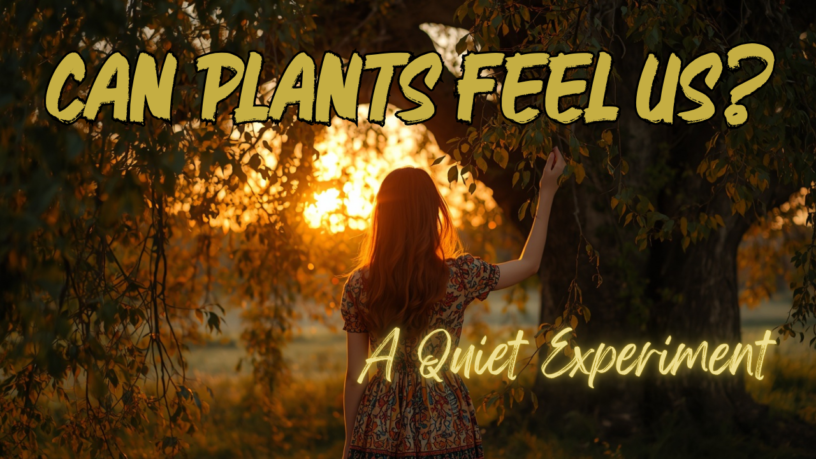
A while ago, I came across a video on TikTok — a woman standing perfectly still in front of a tree, speaking to it quietly, asking it to touch her with its leaves in a particular spot. Nothing more. Just a request, spoken with sincerity, and stillness.
I was curious enough to try it myself. There’s a tree just outside my bedroom window — close enough that I can reach it without even stepping outside. So one day, I stood there, spoke to it the way she had, and asked.
And it answered. Not with a coincidental gust of wind — I know what ordinary wind feels like, and this was not that. It was different. Focused. Almost deliberate. I felt it, and I have not been able to explain it away since.
That small, strange, beautiful moment changed something in how I relate to the plants and trees around me. It planted a question I haven’t stopped asking since: what if the natural world is not as silent, and not as separate from us, as we’ve been taught to believe?
Do Plants Respond to Sound and Intention?
Science has begun, slowly and carefully, to explore what many intuitive traditions have long taken for granted: that plants are genuinely responsive to their environment in ways more sophisticated than we once assumed.
Research into plant bioacoustics has shown that plants respond measurably to vibration — including sound and music. Some studies suggest that harmonious, ordered sound, such as classical composition, correlates with enhanced growth and vitality, while chaotic or discordant sound appears to produce stress responses. Whether plants “enjoy” music in any way comparable to human experience remains scientifically uncertain — but the sensitivity itself, the fact that something registers and responds, is increasingly well documented.
I recently discovered something that illustrates this beautifully — a YouTube channel that captures the actual bioelectric activity of a living, centuries-old Cork Oak tree in Portugal, and translates it into evolving ambient sound through modular synthesis, tuned to 432Hz. Nothing about it is composed to manipulate attention — no sudden shifts, no aggressive rhythm, nothing engineered to grab the mind. Just the slow, organic pulse of the tree itself, made audible.
Listeners describe slower breathing, quieter thoughts, and a felt sense of grounded stillness while listening — as though something in the nervous system recognizes this rhythm, even after generations of distance from it. It feels, in its own way, like powerful evidence for something many of us sense but rarely name: that trees are not silent. We simply haven’t had the tools, until recently, to listen.
An Old Practice, Reconsidered
Long before any of this research existed, many cultures already practiced something remarkably similar in spirit: speaking to plants.
I’ve come to do this myself — quietly, almost instinctively now. Before trimming dry leaves, before repositioning a plant, before any kind of care that involves touching or changing something about it, I speak to it first. A few words. An explanation, almost. I’m going to remove this leaf now. It’s not serving you anymore. This will help you.
It may sound whimsical. But there is a long lineage behind this instinct — from indigenous traditions that treat plants as conscious relatives, to more recent, more speculative theories suggesting that plants growing in a home may be sensitive to the presence and even the emotional state of their caretakers, sometimes even at a distance.
Whether or not this proves true in the strict scientific sense, there is something valuable in the practice itself: treating a living thing with acknowledgment rather than indifference changes the quality of the relationship — even if only on our side of it.
Learning to Welcome Green Things In
For many years, I couldn’t keep a vase of flowers in the house. I had two cats, and one of them — food-motivated in ways only cat owners will understand — could not be trusted around anything green and leafy. Every bouquet I ever received, I gave away almost immediately.
That cat is seventeen now. He doesn’t jump the way he used to, and somewhere along the way, I quietly started reclaiming the parts of my home that had been off-limits for so long.
I began slowly. An orchid, which he seems to leave respectfully alone. Then a coconut palm, a spider plant, and — a recent gift — a Siberian ginseng. I find myself drawn most to the leafy green ones, especially palms; there’s something about their particular shape of aliveness that I love.
It has been a small, quiet joy — learning, after so many years, what it feels like to share a home with growing things again. And now, when I water them, when I turn their leaves toward the light, when I speak to them before I trim what no longer serves them, I find myself wondering what they might be sensing on the other side of that exchange.
An Invitation
You don’t need a garden or a forest to begin noticing this for yourself.
The next time you’re near a plant or a tree — indoors or out — try this simple exercise. Stand close enough to be touched by a leaf or branch. Ask, silently or aloud (the words don’t need to be spoken; a clear thought carries just as well) for it to touch you in a specific place. Your cheek, perhaps. Your shoulder. Somewhere you’ll clearly notice.
Then wait. Give it a few minutes. Don’t force anything, and don’t be discouraged if nothing happens right away. Simply stay present, breathing, open, and ask it to touch you in that spot.
You may feel nothing at first. Or you may feel, as I did standing in front of that tree outside my window, something unmistakably like an answer.
Either way, you will have done something quietly radical in a world that has largely forgotten how to listen: you will have asked, instead of assumed.
And that, perhaps, is where every real relationship — with a person, a place, or a plant — genuinely begins.
If this resonated with you, there is more to explore.
Subscribe to Alma Noble and receive the Mindful Soul Starter Kit as a welcome gift for your journey.
Claim Your FREE Soul Starter Kit





























Leave a Reply