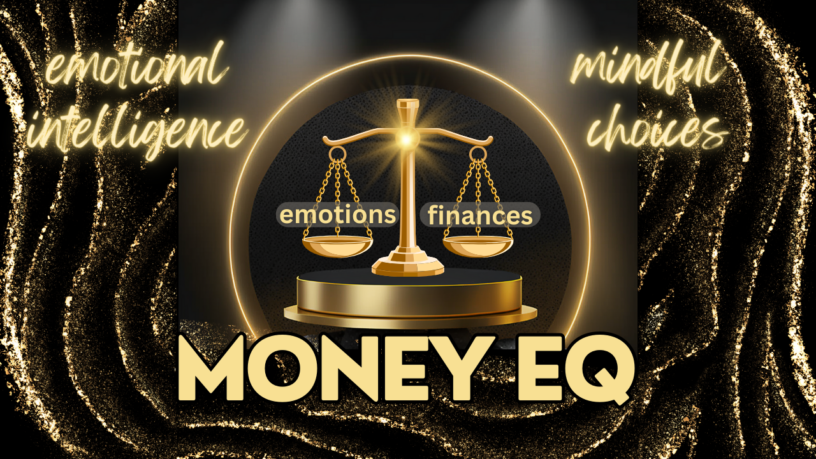



Discover the Hidden Key to True Wealth: It’s All in Your Mindset!
Why Emotional Intelligence May Matter More Than Financial Knowledge
What if the missing piece in your financial life has nothing to do with money — and everything to do with how you feel about it?
Most of us have been taught that financial success is a matter of knowledge and strategy. Learn the right investment principles. Earn more. Spend less. Follow the formula.
And yet — countless people who know exactly what they should do with money continue to sabotage themselves. They earn more and spend more. They save, then splurge. They build something and then, quietly, undermine it.
The missing piece is rarely information. It is almost always emotional.
Welcome to the concept of Money EQ — and why it may be the most important financial skill nobody taught you.
What Is Money EQ?
Emotional Intelligence — EQ — refers to our ability to recognize, understand, and manage our own emotions, and to navigate the emotions of others with awareness and skill.
When we apply this to our relationship with money, we arrive at Money EQ: the emotional intelligence we bring to our financial decisions, beliefs, and behaviors.
A high Money EQ looks like: feeling calm and empowered around financial decisions, understanding why you make the choices you make, and maintaining a healthy, non-anxious relationship with money — regardless of how much or how little you currently have.
A low Money EQ looks like: constant worry about money even when there is enough, impulsive spending followed by guilt, avoiding financial decisions out of fear, or feeling that no matter what you earn, it is never quite enough.
Here is the surprising part: many highly educated people — those with MBAs, advanced degrees, impressive investment knowledge — have a high money IQ and a low money EQ. They build elaborate financial structures on an unstable emotional foundation. And eventually, that foundation shows.
Money EQ is not about what you know about money. It is about how you feel about it.
The Surprising Link Between Emotions and Finances
We readily accept that emotions shape our relationships, our health, our creativity. But when it comes to money — supposedly the domain of logic and numbers — we tend to assume emotions are irrelevant.
They are not.
Fear of scarcity drives hoarding or avoidance. Guilt around wealth leads to unconscious self-sabotage. The thrill of spending becomes a substitute for emotional needs that money was never designed to meet. Old beliefs inherited from childhood — money is hard to come by, rich people are greedy, I don’t deserve abundance — operate silently beneath every financial decision we make.
These are not weaknesses. They are patterns — and patterns, once recognized, can be changed.
The Benefits of Developing High Money EQ
Clearer decision-making When you understand your emotional triggers around money, you become less vulnerable to impulsive decisions and more capable of choices rooted in genuine values and long-term vision.
Reduced financial stress Much of financial anxiety is not about actual scarcity — it is about the emotional meaning we attach to money. Developing Money EQ creates a sense of inner stability that external circumstances cannot so easily disturb.
Better communication about money Whether in partnerships, families, or business relationships, financial conversations are often emotionally charged. Higher Money EQ allows you to navigate these conversations with more empathy, clarity, and less defensiveness.
Goals that actually align with who you are Emotionally intelligent people set financial goals rooted in genuine values — not in what they think they should want, or what looks impressive to others. This alignment makes commitment to those goals far more sustainable.
A healthier relationship with money itself Not obsession, not avoidance — but a balanced, respectful, even appreciative relationship with money as a tool that serves your life rather than dominates it.
Before the Strategies — A Few Reflections Worth Sitting With
Before diving into practical tools, it helps to pause and ask some honest questions:
What did you learn about money growing up? Was it scarce, stressful, taboo? Or was it discussed openly and approached with ease?
What emotions arise when you check your bank account? Anxiety? Guilt? Indifference? Relief?
Do you believe, at a deep level, that you deserve financial wellbeing — or does some part of you feel that abundance is for other people?
These are not rhetorical questions. They are the beginning of the real work. Because until you understand the emotional architecture beneath your financial behaviors, no strategy will hold for long.
Practical Strategies for Enhancing Your Money EQ
1. Develop Self-Awareness Begin by noticing your emotional responses to money-related situations — not judging them, simply observing. Anxiety before checking your balance. Guilt after a purchase. Excitement before a big spend. These reactions are data. They point to the beliefs and wounds underneath.
2. Identify Your Money Scripts Money scripts are unconscious beliefs inherited from family, culture, and experience — there is never enough, money corrupts, I have to work hard to deserve it. Bringing these beliefs into conscious awareness is the first step to rewriting them.
3. Practice Mindfulness Around Financial Decisions Before making a significant financial choice, pause. Breathe. Ask: Am I acting from clarity or from emotion? From genuine need or from fear, impulse, or a desire to fill something that money cannot fill?
4. Develop Self-Regulation Emotions will arise around money — that is human and unavoidable. Self-regulation means creating enough space between the emotion and the action to make a conscious choice rather than an automatic reaction.
5. Practice Empathy With yourself first — understanding why you make the choices you make, without shame. And with others — recognizing that everyone carries their own emotional history with money, and that financial conflicts are rarely only about money.
6. Align Goals With Values Ask not just what do I want financially? but why do I want it? The emotional why — the meaning behind the goal — is what sustains commitment when motivation fades.
7. Practice Gratitude Gratitude shifts the nervous system from scarcity to sufficiency. Regularly acknowledging what is already present — financially and otherwise — recalibrates the emotional baseline from which all decisions are made.
8. Reflect and Adjust Money EQ is not a destination. It is an ongoing practice of noticing, learning, and refining. When a financial decision leads to regret, approach it with curiosity rather than criticism: what was I feeling? What did I believe in that moment? What would I choose differently?
A Final Reflection
Financial knowledge will tell you what to do with money.
Money EQ will help you actually do it — and more importantly, will transform the relationship you have with money at its root.
Because true financial wellbeing is not only about the numbers in your account. It is about the peace you feel when you think about money. The clarity with which you make decisions. The freedom that comes from understanding yourself well enough to stop repeating patterns that no longer serve you.
The path to abundance begins not in your bank account — but in your beliefs, your emotions, and the quiet, honest work of knowing yourself. 🌿
If this resonated with you, there is more to explore.
Subscribe to Alma Noble and receive the Mindful Soul Starter Kit as a welcome gift for your journey.
Claim Your FREE Soul Starter Kit





























Leave a Reply