
The 7-Year Cycles of Human Life: A Map You Didn’t Know You Were Following
What if your life has been unfolding exactly as it should — and you simply didn’t have the map?
There is a particular kind of comfort that arrives not from answers, but from recognition. The moment you read something and think: yes. That’s it. That’s exactly what happened. Not as a theory. As a lived experience, suddenly named.
I had that moment recently, reading a fragment from Bernard Werber’s Empire of the Angels — a passage that outlines the great cycles of human life, each spanning seven years, each with its own inner logic, its own lessons, its own necessary storms.
I read it once. Then again. And then I sat with it for a while, tracing my own life against its framework — recognizing, with a strange mixture of relief and wonder, that I had lived every single one of these cycles almost exactly as described.
Perhaps you will too.
Why Seven Years?
The number seven has always carried a particular resonance — in ancient traditions, in numerology, in the rhythms of nature. But beyond symbolism, there is something functionally true about seven-year cycles in human development.
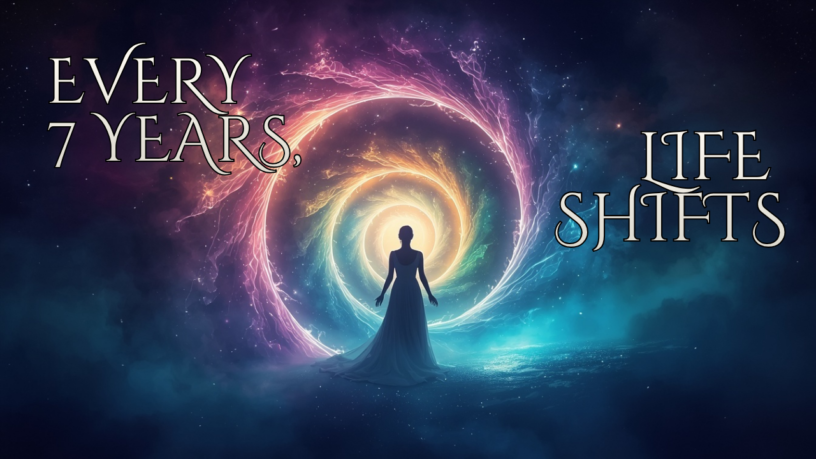
Every seven years, something shifts. Not always dramatically. Sometimes quietly, almost invisibly. But when you look back from a distance, the transitions are unmistakable — a different version of yourself, standing at a different threshold, facing a different set of questions.
Werber’s framework doesn’t explain why these cycles exist. It simply maps what happens when we move through them — and in doing so, offers something rare: the possibility of understanding your own life not as a series of random events, but as a coherent, purposeful unfolding.
The Cycles — A Map of the Human Journey
0 to 7 — The World of the Mother
“There is a strong connection with the mother. Knowledge of the world happens horizontally. The senses are created.”
This is the period of pure absorption. The child doesn’t yet think — it feels. The smell of the mother, the warmth of her presence, the sound of her voice: these are the first coordinates of reality. Safety is not a concept here. It is a sensation, either present or absent.
What happens in these seven years leaves an imprint that can take decades to fully recognize. The quality of that first bond — the security, the attunement, the consistency of love received — becomes the unconscious template through which all future relationships are filtered.
We spend much of our adult lives either honoring or healing what was built here.
7 to 14 — The World of the Father
“A strong connection with the father is created. Knowledge of the world happens vertically. Personality is formed.”
The child turns outward. The mother offered roots — the father offers wings. He becomes the bridge between the warmth of home and the complexity of the world beyond it. Through him, the child learns that the world can be navigated, that it has structure, that there are rules — and that those rules can be mastered.
Personality begins to crystallize here. The child starts to understand who it is in relation to others — not just within the safety of family, but in the wider landscape of peers, school, society.
Whether the father was present or absent, engaged or distant, this period shapes the child’s relationship with authority, ambition, and the outer world for years to come.
14 to 21 — The Age of Revolt
“Revolt against society begins. Matter is discovered. The intellect is formed.”
And then — the storm.
The adolescent doesn’t just question the world. They want to dismantle it. The structures that once felt protective now feel suffocating. Rules exist to be broken. Values inherited from parents are tried, tested, and often temporarily rejected.
This is not dysfunction. This is necessary.
The revolt of adolescence is how the self learns to distinguish what it has inherited from what it actually believes. It is the friction that forges an independent mind. The loud music, the fierce friendships, the romantic intensity, the flirtation with anarchy — all of it is the psyche’s way of asking: who am I, if not simply the product of what I was handed?
The cycle closes, ideally, with the beginning of an answer.
21 to 28 — Integration
“Integration into society. Stabilization after revolt.”
The revolutionary softens — not from defeat, but from maturity. Having failed to change the world overnight, the young adult begins the more patient work of finding their place within it.
A job. A partner. A home. The building of what Werber calls the first cell — the private universe of one’s own creation.
This is also the period of comparison: the unconscious impulse to do it better than the generation before. A better relationship than the one witnessed in childhood. A more fulfilling career. A home that feels different — lighter, freer, more chosen.
The cycle typically closes with the formation of a committed partnership — the first real attempt at building a life deliberately, rather than inheriting one.
28 to 35 — Building the Cell
“The family home is created. Values accumulate within the cell.”
This is the period of construction — and of testing. The structures built in the previous cycle are now stress-tested by reality: children, mortgages, careers, ageing parents, the slow revelation of who your partner actually is beneath the initial projection.
And here, Werber offers something worth sitting with: if the previous cycles have not been lived fully, the cell begins to crack.
Unresolved wounds with the mother create tension with in-laws. Unhealed patterns with the father resurface in the workplace. The revolt that was never truly completed turns inward, or outward in destructive ways.
Thirty-five, he suggests, is the age at which an incompletely ripened life often breaks open. Divorce. Career collapse. Depression. Not as punishment — but as invitation. The psyche’s insistence that what was avoided must now be faced.
35 to 42 — Beginning Again
“Everything starts from zero. Enriched by experience and mistakes, the person rebuilds a second cell.”
There is a particular kind of wisdom that only crisis can deliver.
Those who move through the breaking of the first cell — whether through divorce, loss, professional failure, or simply the slow recognition that something essential is missing — emerge with something they didn’t have before: the knowledge of what they actually need, as opposed to what they thought they wanted.
The second cell is built differently. More consciously. With less performance and more discernment. The partner chosen now is chosen with eyes more open. The work pursued now is chosen more for meaning than for approval.
If the lessons have been learned. If not — the same patterns reconstruct themselves in new clothing, and the cycle repeats.
42 to 49 — Conquering the World
“Once the improved second cell has been created, the person begins to feel the fullness of life.”
This is, in many ways, the peak of the external journey.
The storms of earlier decades have passed — or at least quieted. There is competence now, hard-won. There is a place in the world, established through genuine effort. There is, often, a sense of arrival.
And it is precisely here that the cycle divides into two paths.
One path deepens the pursuit of material success — more wealth, more comfort, more influence. The other turns inward, toward something that cannot be accumulated: the authentic self.
The cycle closes with a crisis that is, in truth, an opening — the great existential questions arriving not as threats but as invitations: Why am I here? What is truly mine to do? What does a meaningful life actually look like, beyond what I’ve been told it should?
49 to 56 — The Spiritual Revolution
“If the person has succeeded in creating or rebuilding their cell and has fulfilled themselves in family and professionally, they naturally seek wisdom.”
Something loosens at this threshold. The need to prove, to perform, to accumulate — it doesn’t disappear, but it loses its urgency. What rises in its place is harder to name but unmistakable once felt: a hunger for depth. For truth. For the kind of understanding that no career achievement or relationship milestone can provide.
This is the cycle I find most quietly profound. Not because it is the most dramatic — it isn’t. But because it is the most honest. The masks worn for decades become heavier. The questions asked now are real questions, not rhetorical ones.
Reading this particular passage, I recognized something in myself. The sense that life, viewed from this vantage point, becomes less about accumulation and more about distillation. Less about adding and more about understanding what was always essential.
If lived with sincerity, Werber writes, this search will have no limits, and will continue until the end of life.
I believe him.
The Map Is Not the Territory — But It Helps
No framework captures the full complexity of a human life. We are not all living the same story, on the same timeline, through the same experiences.
Some of us move through these cycles early. Some repeat them. Some experience their spiritual revolution at thirty, their revolt at fifty. Life is not a straight line, and neither is growth.
But what Werber’s map offers — and what I find genuinely valuable about it — is the invitation to see your life as a coherent whole rather than a series of disconnected events. To understand that the crisis at thirty-five was not a failure but a transition. That the questioning at fifty is not a breakdown but an awakening. That the storms, the rebuildings, the losses and the beginnings — all of it belongs.
All of it has been moving you somewhere.
A Question Worth Asking
Where are you in the map?
Not where you think you should be — but where you actually are. Which cycle are you living? Which one are you still completing? Which questions are beginning to surface that you haven’t yet found the courage to sit with?
The map doesn’t tell you what to do. But it reminds you that you are not lost.
You are simply in the middle of the next chapter. ✨
If this resonated with you, there is more to explore.
Subscribe to Alma Noble and receive the Mindful Soul Starter Kit as a welcome gift for your journey.
Claim Your FREE Soul Starter Kit























Leave a Reply